How our sizes run, and where our notes stop
Three notes, and why those three
Every piece here carries the same three notes: whether the fabric stretches, whether it is sheer, and how long it is. They are not there because they are easy. They are there because they are what people write to the studio about.
Nobody has ever asked us what a dress weighs. Plenty of people have asked whether they can wear a normal bra with it.
- No stretch37
- Slight55
- Some412
- Stretchy395
Taken from the piece itself, not from a fabric chart.
Stretch decides your size, not your taste
Stretch is first because it changes which size to take. 37 pieces in the range have no stretch at all, and on those the number you normally buy is the number to buy here. A woven with no give has no tolerance for a hopeful size down.
A rib knit is the opposite. It pulls across the body and returns, so a size down often reads better and a size up reads like a sack.
| Note | What it means for sizing | Where it turns up |
|---|---|---|
| No stretch | Take your usual size, no rounding down | Woven satin, denim, linen |
| Slight | Usual size, a seam will give a little | Cotton blends, some jersey |
| Some | Usual size, forgiving through the waist | Ponte, heavier knits |
| Stretchy | A size down often fits better | Rib knits, bodycon, activewear |
We take the word from the piece itself rather than from a fabric chart. When the piece says no stretch, that is what goes in the note.
Sheer is a yes or no, not a degree
Sheer is the note people thank us for and the one brands usually leave to the photograph. 89 pieces in the range are sheer. 2 are lined.
We do not grade it. A piece is either sheer enough that you will want something under it or it is not, and a scale of one to five would only give us room to be optimistic.
Mesh and lace are sheer by construction, so the note repeats what the fabric word already told you. White cotton in strong light is the one that catches people out, and the note is the only warning you get.
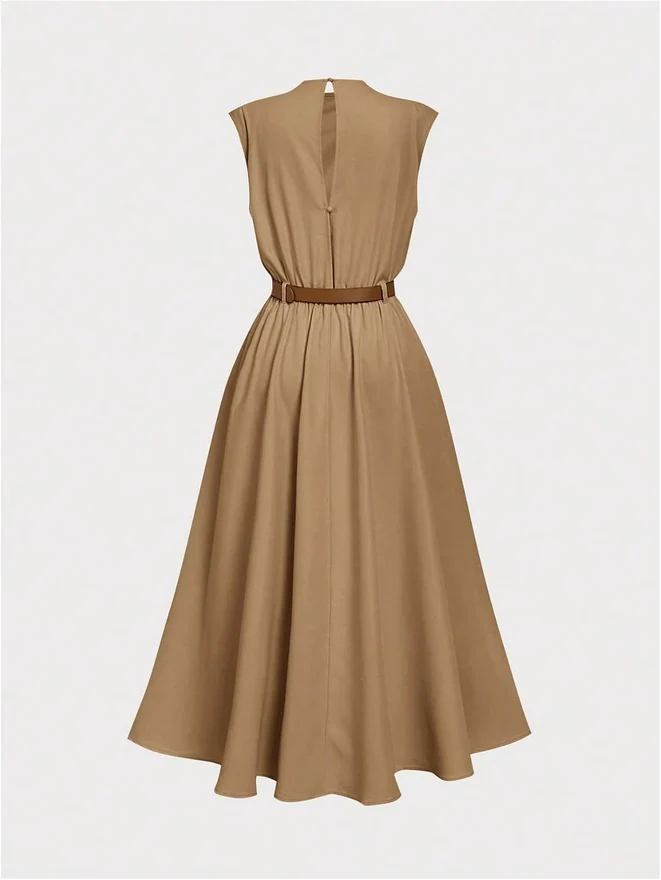
A dress from the range. The length note matters more than the photograph, because the photograph is one height.
Length is the note we are least able to give you
Here is where our notes stop, and we would rather say it than let you find out. We write maxi, midi, mini and cropped. We do not publish a measurement in inches from shoulder to hem.
The reason is the one in the care rule that we take seriously everywhere else: you have to have a reasonable basis for what you say. Stretch and sheerness come from the piece itself, so those we can stand behind. A measured length for every size of every shape is beyond what the studio has checked, and printing one would be guesswork.
What we can tell you is how the words fall across the range, and that a mini on a tall frame is a different garment.
Plus sizes are cut, not scaled
88 pieces are made in plus sizes. On those the shape is cut for the size rather than graded up from a small, which shows most at the armhole and the waist seam.
A garment graded up without recutting gets wider everywhere at once. That is how you end up with a dress that fits the hip and gapes at the chest.
- Cut oneA sample in the real cloth, not a toile in something cheaper.
- Wear it a weekSomeone in the studio lives in it, sits in it and washes it.
- Write the notesStretch, sheerness and length go down as they are, not as we wish.
- Make it properlyOnly shapes that survived the week reach the rails.
We are not going to claim we get this right every time. We are saying which rail was cut that way, so that a piece that disappoints you is a piece we should hear about.
One closing note on what none of this covers. A size chart on a product page is a garment measurement, not a body measurement, and the two are not the same number. Ours is no exception.
If the notes on a piece and the garment in your hands disagree, that is worth an email. The address is in the footer and it reaches the room where the sample was cut.
Sources
Read in full with our own browser on 18 September 2026. Quotations above are word for word and are checked against the saved text on every build.
- 16 CFR Part 423, Care Labeling of Textile Wearing Apparel. Federal Trade Commission, current text in the Electronic Code of Federal Regulations. Read 18 September 2026.
- 16 CFR Part 303, Rules under the Textile Fiber Products Identification Act. Federal Trade Commission, current text in the Electronic Code of Federal Regulations. Read 18 September 2026.
This journal is about clothing, not health, money or safety. Nothing here is legal advice.