What a care label has to tell you
The tag is the document, the page is not
The little tag sewn into a side seam is not decoration and it is not our choice. Textile wearing apparel sold in the United States has to carry care instructions, and the rule that says so is short enough to read in an afternoon.
It starts from where the tag lives. A label you cannot find before you buy does no work, so the rule puts that first.
Manufacturers and importers must attach care labels so that they can be seen or easily found when the product is offered for sale to consumers.
16 CFR Part 423, Care Labeling of Textile Wearing Apparel, § 423.6(a)
What it must actually say
The next requirement is the one people assume and rarely check. A care label is not free to say something vague and sympathetic. It has to name the care the garment needs in ordinary use.
In practice that means one of two routes. A washing instruction or a drycleaning instruction, and if a washing instruction is given it has to name hand or machine, and a water temperature in words a person uses at home.
Care labels must state what regular care is needed for the ordinary use of the product.
16 CFR Part 423, Care Labeling of Textile Wearing Apparel, § 423.6(b)
Tumble dry means that a high, medium, or low temperature setting can be used.
16 CFR Part 423, Care Labeling of Textile Wearing Apparel, § 423.6(b)(1)(ii)
The rule also fixes what the shorthand means, so that two brands cannot use the same three words for two different things.
What the words mean when they appear
Ironing is the clearest example of a phrase that is absent for a reason. If a label says nothing about an iron, that is information, not an oversight.
And the part of the rule that matters most to a shopper is the last one, because it is the one nobody can see. A brand is not allowed to guess.
Ironing must be mentioned on a label only if it will be needed on a regular basis to preserve the appearance of the product
16 CFR Part 423, Care Labeling of Textile Wearing Apparel, § 423.6(b)(1)(iii)
To fail to possess, prior to sale, a reasonable basis for all regular care information disclosed to the purchaser.
16 CFR Part 423, Care Labeling of Textile Wearing Apparel, § 423.5(a)(5)
What our own pages carry, counted
Here is where we have to be straight about our own site. The care rule governs the label attached to the garment. It does not govern a product page, and our product pages are not written to replace it.
We counted. Across the 1,064 pieces on the rails today, 138 carry a washing, drycleaning or bleaching word in the notes we publish. The rest say nothing about care at all, because nothing about their washing has reached us in a form we would put in print.
That is an uncomfortable number to print and it is the honest one. If care matters to your decision, buy the piece and read the tag, and send it back if the tag and your machine disagree.
What we would look at instead
Until the tag is in your hand, the useful signals are the ones we do publish on every piece. Fabric words tell you roughly how a cloth behaves in water. Stretch tells you whether a seam is under tension when you sit.
Satin and sequins are the two that catch people out. Woven satin marks when it gets wet in one spot and dries in a ring. Sequins snag on everything in a drum, including themselves.
Our sleep rail is mostly satin, so that warning is not abstract. 64 pieces sit there, and the ones we would hand wash are the ones with lace at the edge.
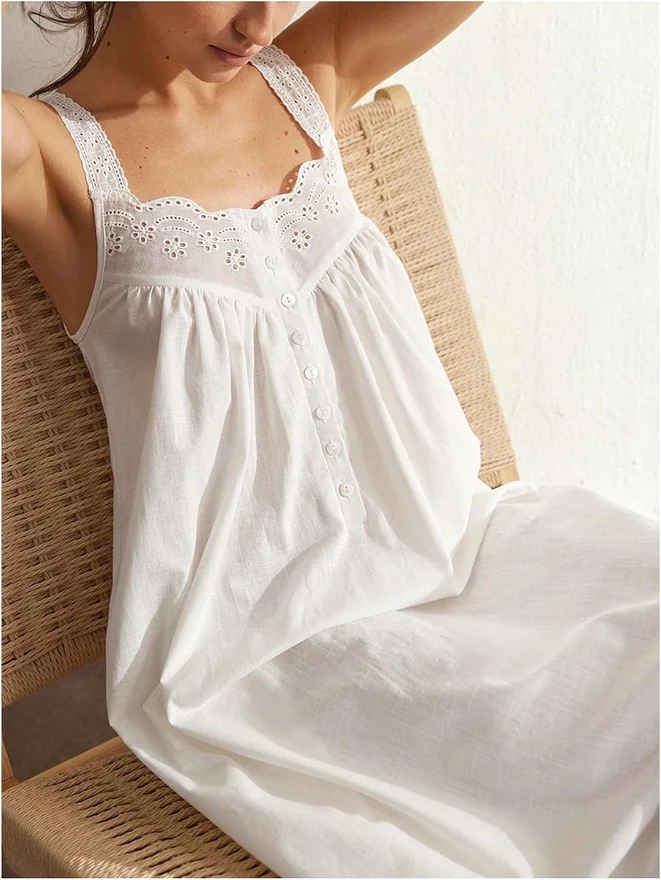
Satin from our sleep rail. Cool against the skin, no stretch at all, and unforgiving about a spot cleaned in one place.
One last thing worth saying plainly. A rule about labels is a rule about honesty, not about quality. A label that says dry clean only is complying with the rule. It is also telling you that this piece will cost money every time you wear it.
Read it before the wedding, not after.
Sources
Read in full with our own browser on 18 September 2026. Quotations above are word for word and are checked against the saved text on every build.
- 16 CFR Part 423, Care Labeling of Textile Wearing Apparel. Federal Trade Commission, current text in the Electronic Code of Federal Regulations. Read 18 September 2026.
This journal is about clothing, not health, money or safety. Nothing here is legal advice.